

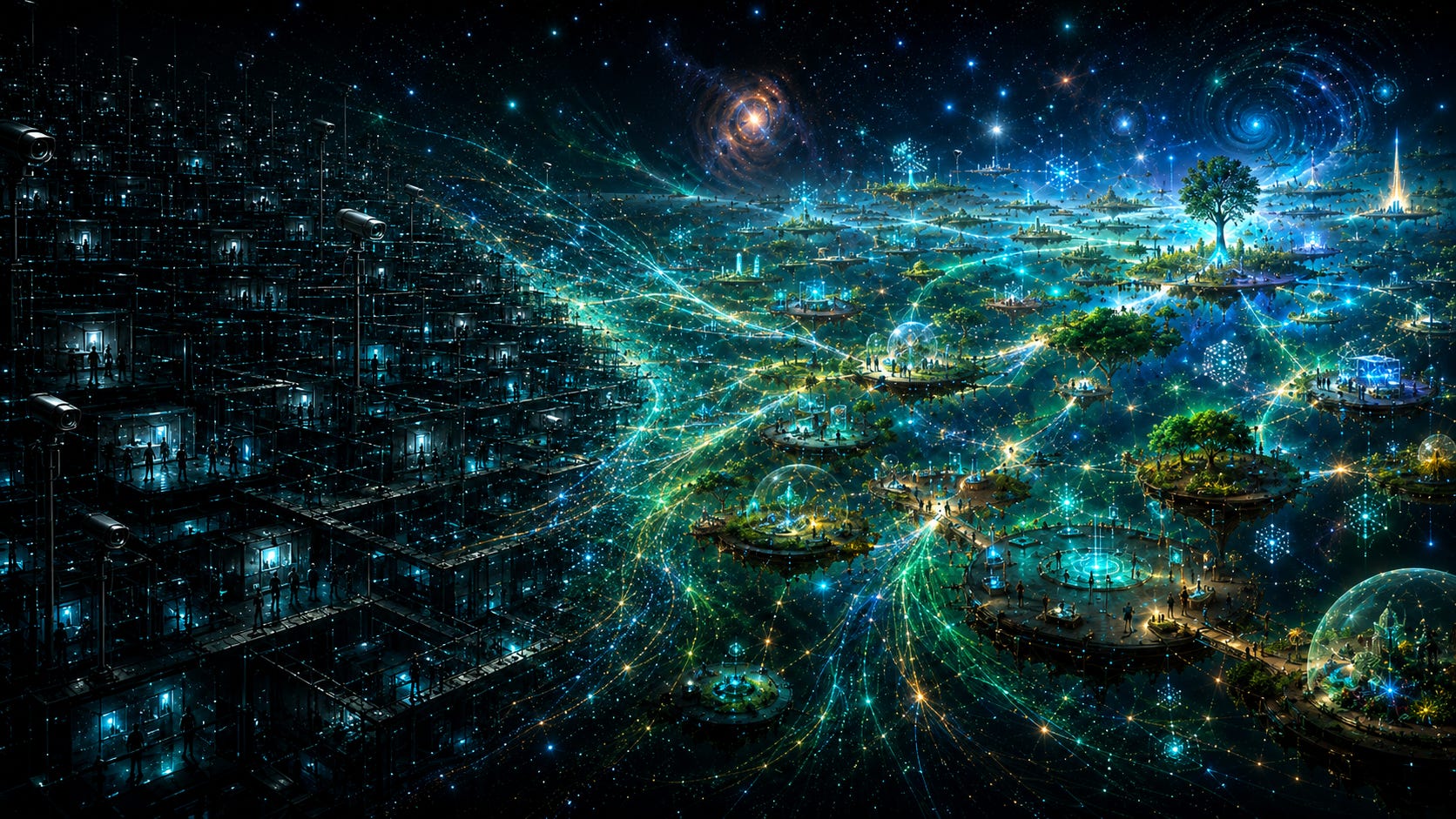
Time is accelerating, if you measure it by the number of events that happen every second, it’s passing faster than ever. A second hasn’t gotten shorter but the number of events happening per second is growing exponentially. A year now contains more change than a decade used to.
The world was already too complex to predict specific futures. The explosion in events is making it even harder. Every new discovery or invention expands the adjacent possible and creates possibilities that did not exist the day before. We can sometimes predict general directions (problems remain solvable, change is inevitable), but precise prediction has become almost impossible.
And somehow we still have a group of people that insists on regulating the rest of us according to the future they see.
We’ve made this same mistake many times in the past, entire political systems are based on the belief that society can be predicted and controlled. And time and time again we’ve seen the opposite: progress comes from the freedom to think, combining ideas, and running open systems that can self-correct, instead of closed systems trying to prevent mistakes. Aiming for utopia has always left us poorer and less free.
Closed systems require two things from the central controller: good intentions and the ability to predict and optimize the future. And because they are built around a specific prediction, they are inherently static and inflexible. When reality diverges from the plan (it always does), they can’t adapt.
Open systems work better because they don’t require anyone to be a prophet. They are dynamic. They assume from the start that we are fallible, that problems will appear, and that most of our current ideas are incomplete or wrong. Instead of trying to prevent every mistake, they maximize the ability to detect and correct errors.
Bad things still happen in both, but open systems are built to adapt. They treat problems as solvable rather than as justifications for more control. They handle uncertainty better.
We’ve never had more uncertainty than right now. AI is the ultimate accelerator, it’ll help us generate new knowledge and new tools at a rate never seen before. It will also create new problems, that’s inevitable. And we can either design these new systems to be as open and self-correcting as possible, or bet everything on our ability to predict and control what comes next.
On the closed side we have governments pushing for KYC to use the internet and banning companies from offering their services to the world. Companies claiming that AI should be closed and controlled by them because, of course, they are the only ones capable of building God.
All of it pushed by doomers who believe they are smart enough to predict future catastrophes: AI turning us into paperclips (via a dumb goal in the most intelligent system ever), average people creating bioweapons in their garages (while somehow not helping billions defend against them), or a permanent underclass (thanks to the most rapidly democratized technology in history).
On the open side we have the historical record: capitalism outperformed communism, democracy outperformed authoritarianism, the scientific method , the open internet. In politics, economy, science, and technology, open systems have consistently beaten closed ones.
They are messier and bring problems, and that’s the reason why people keep trying to build perfect, problem-free systems from the top down. But problems are solvable and open systems are great at that. Utopian projects are at best naive dreams, and at worst propaganda for more control.
We already have the tools required to push our systems in the open direction: open-weight models that anyone can run privately and uncensored on open-source stacks, crypto as the infrastructure to have decentralized, trustless systems, and the internet as both the base layer for all human knowledge and the clearest proof that a messy open protocol can change the world for the better.
The future is unimaginable as Stewart Brandt says, and that is precisely why we should refuse systems that require someone to imagine it for us, and push for systems that maximize freedom and optionality for all.